

One of the hardest parts of software engineering is not building software.
👉🏼 It is shipping it with confidence.
Because releasing software should not feel like a coin toss, especially not on a Friday at 6 p.m., when everybody is already mentally halfway into the weekend, and the margin for dealing with surprises is much smaller than we would like to admit.
If every release feels risky, the problem is usually not the release itself. The problem is the system behind it.
In today’s issue, I want to share a different way of looking at that feeling of uncertainty that appears right before going to production, and why, in most cases, it is not something you fix at release time, but something you design away much earlier in the process.
Let’s begin with the elephant in the room.
The invisible weight behind every release
👉🏼 Releases do not become stressful in isolation.
They accumulate friction over time, through a combination of small issues that individually seem manageable, but collectively create a system that is harder to reason about and, therefore, harder to trust.
Some of those signals usually look like this:
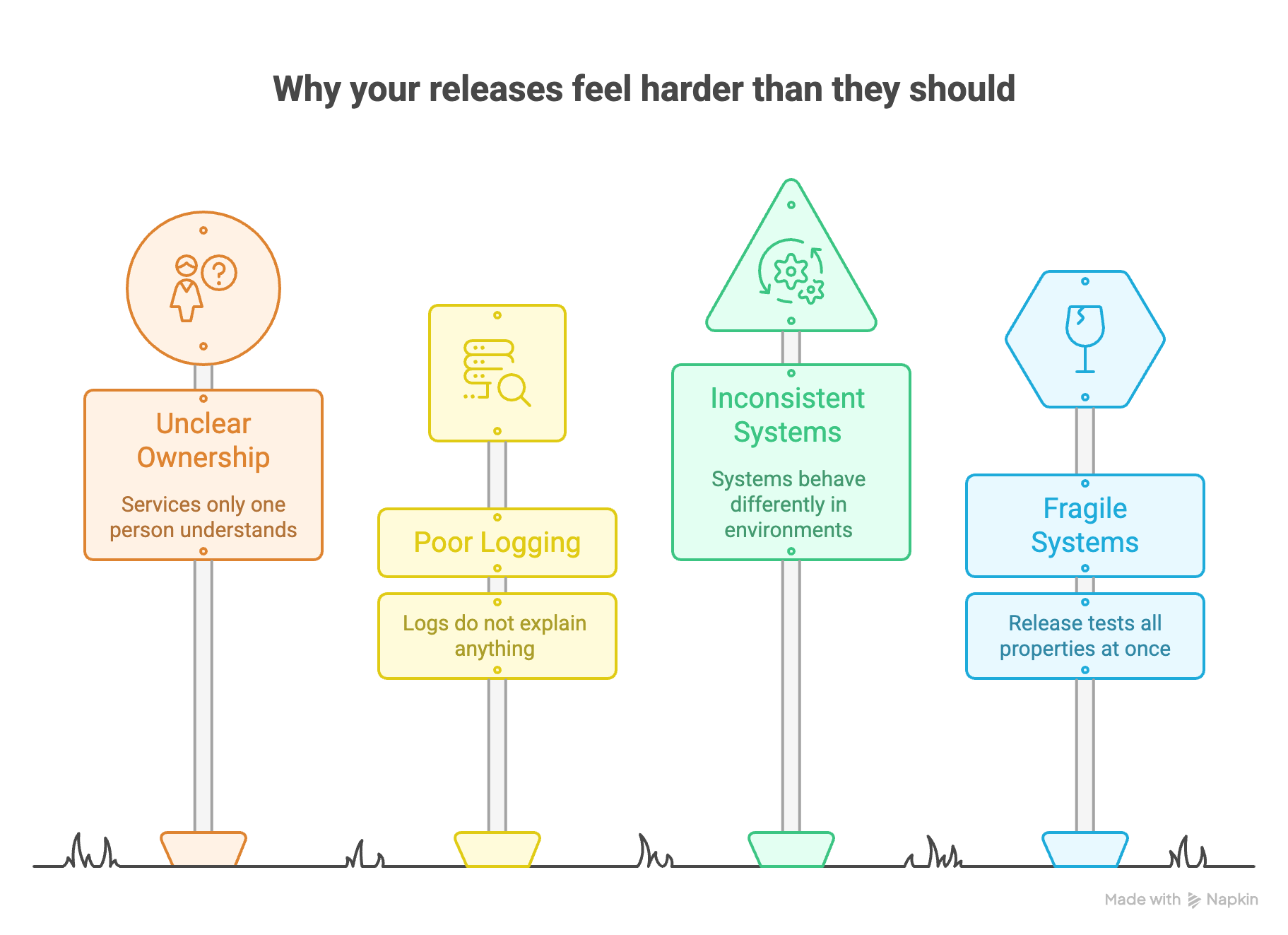
Ownership is not completely clear, so when something goes wrong, there is a small but real hesitation about who should act first.
Parts of the system are only fully understood by one or two people, which silently increases the perceived risk of touching them.
Logs exist, but they do not really explain what is happening, forcing you to reconstruct the story under pressure.
Alerts either come too late or too often, which makes them easy to ignore when they actually matter.
Environments behave slightly differently, in ways that are not always obvious until something breaks.
None of these things breaks a release on their own.
But together, they create a system where every change feels heavier than it should, and that weight tends to show up exactly when you least want it to: right before going to production.
Confidence is not a feeling, it is a property
👉🏼 Many teams treat confidence as something emotional, something that needs to be discussed or agreed upon before releasing.
Do we feel safe releasing this?
But confidence is not something you convince yourself of in a meeting.
It is something your system gives you, almost by default, when the right properties are in place.
A system that behaves well tends to share a few characteristics:
It is easy to understand, which means that most engineers can reason about what a change will do before it happens.
Responsibilities are clear, so when something goes wrong, there is no ambiguity about who owns the next step.
It explains itself through logs and signals that help you understand what is happening without guesswork.
It behaves consistently across environments, reducing the number of surprises when moving to production.
When those pieces are in place, confidence stops being a discussion and becomes an outcome.
Where most teams get it wrong
👉🏼 The common mistake is trying to “fix the release” instead of fixing the system that produces that release.
That usually leads to adding more layers around the moment of deployment:
More checks.
More approvals.
More manual verification.
More last-minute coordination.
All of these can help in the short term, and sometimes they are necessary.
But they rarely address the root of the problem.
Because the release is just the moment where all the properties of your system are tested at once, under real conditions and real pressure.
If the system is hard to understand, the release will feel risky.
If the system is inconsistent, the release will feel unpredictable.
If the system is fragile, the release will feel stressful.
Trying to fix the release without fixing the system is like trying to move faster on a road full of potholes; you might get away with it a few times, but the underlying problem is still there.
A simpler way to think about it
Instead of asking:
Is this release safe?
It is often more useful to ask:
Does our system make safe releases the default?
That shift may seem subtle, but it changes where you put your effort.
It moves your attention:
From the moment of deployment 👉🏼 to the way the system is built.
From last-minute checks 👉🏼 to everyday engineering practices.
From reacting to problems 👉🏼 to designing systems that are easier to trust.
And that is where most of the leverage actually is.
Now, some homework for you.
A small exercise
Think about your last release, not just in terms of code, but in terms of experience.
Try to recall the moments where you slowed down, hesitated, or double-checked something “just in case”, even if everything looked correct on the surface.
Ask yourself:
Where did I hesitate, even slightly?
What did I feel the need to double-check before moving forward?
Which part of the system made me feel uncertain or uncomfortable?
Those moments are not random but signals.
They are pointing to parts of your system that are asking for more clarity, more consistency, or better feedback.
👉🏼 If you start paying attention to those signals, release after release, you are not just making the next deployment safer. You are gradually building a system that is easier to understand, easier to operate, and ultimately easier to trust.
Shipping software will never be completely risk-free, but it should not feel like guesswork either.
And when it does, it is usually telling you exactly where to look.