

I find that leadership style matters more and more. I’m personally exposed to multiple styles of leadership.
My experience says that it’s important that you can recognize the leadership style you are exposed to, so you are conscious when something happens to you.
Because of this, I decided to perform research about leadership styles in StartUp-like companies, focusing on research papers and specialized journals, and I bring it to you so you don’t have to do it. I put the links to my sources at the end of the email.
In today’s technology sector, U.S. companies tend to exhibit a dynamic, competitive, and growth-oriented leadership style, whereas European firms often emphasize stability, collaboration, and consensus.
Recent studies highlight that in the U.S., innovative organizations operate at accelerated paces, set highly ambitious goals, and tolerate calculated risks, fostering visionary and transformational leaders who drive teams toward innovation and rapid growth.
Conversely, European leadership tends to be more empathetic and transactional, with CEOs promoting empowerment and internal collaboration.
In today’s issue, you will understand the differences between large tech corporations (FAANG) and startups: established corporations blend formal structure with disciplined innovation, while startups prioritize flexible environments and exemplary leadership that inspires teams.
Finally, we analyze which organizational culture (e.g., adhocratic vs. hierarchical) best fits each leadership approach. In conclusion, there is no single optimal model; leadership effectiveness depends on alignment with cultural context, company size, and stage of development .
🇺🇸 Leadership Characteristics in the United States
Within U.S. technology companies, particularly in Silicon Valley, leadership is predominantly visionary and growth-focused.
These leaders operate at an extremely accelerated pace, often working with short-term (quarterly) business plans and aiming to double company size within a year or two.
In this environment, the competition for talent is everywhere, so firms actively cultivate their internal culture to attract and retain qualified professionals.
USA leaders are typically charismatic and transformational, focusing on motivating teams toward innovation and achieving ambitious objectives. Moreover, they must possess high emotional intelligence and the ability to influence and coordinate global teams without always relying on formal authority. Practically speaking, this means making rapid decisions, tolerating creative dissent, and taking calculated risks. All while maintaining direct, performance-oriented communication.
🇪🇺 Leadership Characteristics in Europe
In contrast, European tech leadership is perceived as more collaborative and consensus-driven.
Leaders in Europe prioritize values such as empowerment, cooperation, transparency, and trust.
They tend to be diplomatic and participative, focusing on quality, process continuity, and collective well-being. Indeed, Spencer Stuart studies show that European software CEOs value empathy and continuous self-improvement as critical competencies.
Their communication style is often more indirect and consultative, seeking harmony and avoiding open conflict.
Generally, European companies are more risk-averse; they compete with the advantage of a favorable regulatory environment but have lower tolerance for bold gambles. This approach results in a leadership style that is more transactional and pragmatic, emphasizing careful planning and team commitment to the corporate vision.
🗺️ Key Differences Between the Two Styles
Let’s see the main differences on 4 dimensions:
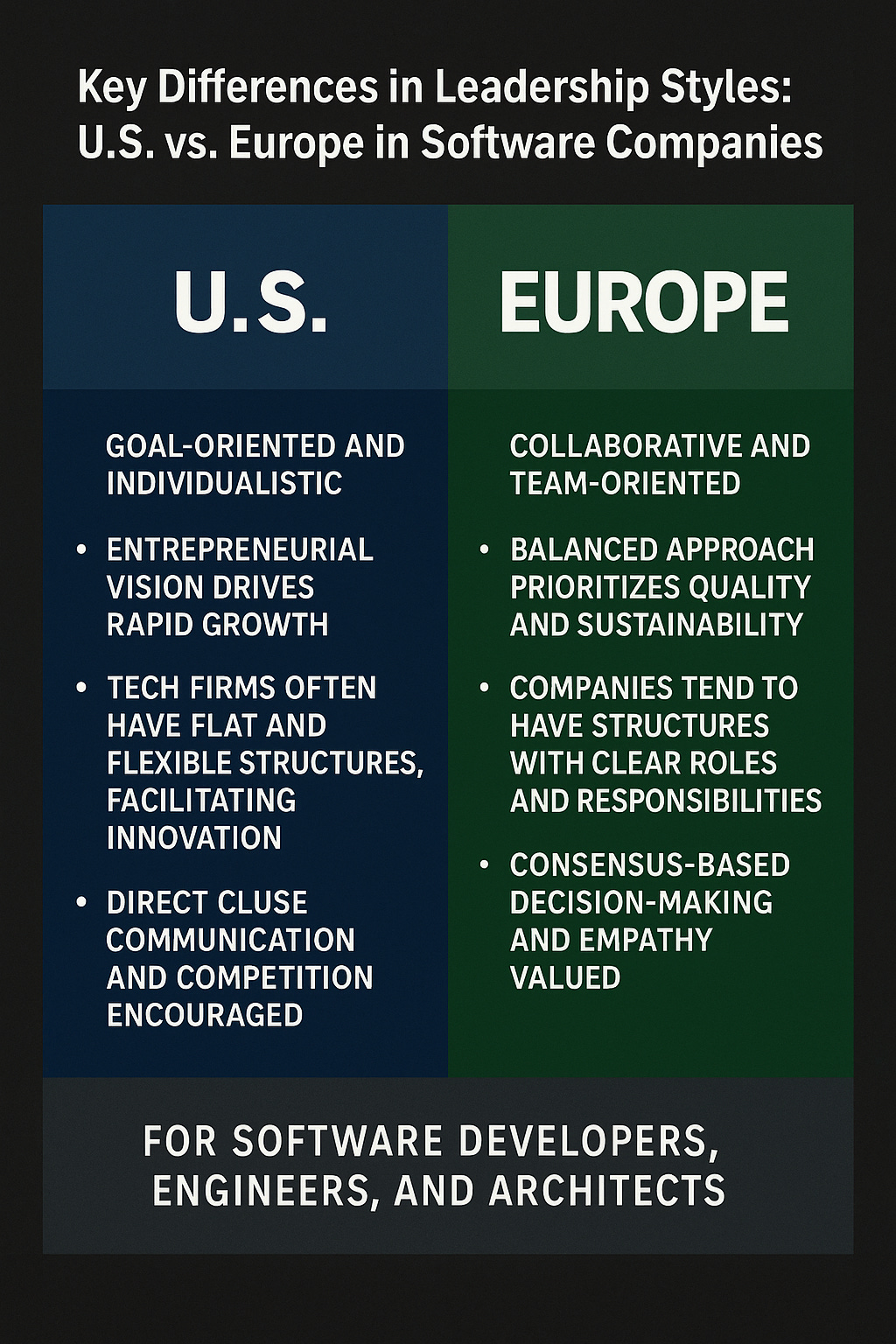
Speed and Risk: In the U.S., decision-making is generally rapid and growth-oriented, with leaders tolerating risk and fostering disruptive change, while in Europe the approach is more cautious and planned, valuing stability over uncertainty.
Individualism vs. Collaboration: The American style highlights individual initiative and personal achievement, rewarding outstanding performance, whereas European leadership emphasizes teamwork and consensus; European leaders seek group harmony and prefer consultative decision-making.
Organizational Structure: U.S. tech firms often have flat and flexible structures, facilitating continuous innovation. In contrast, European companies tend to be more hierarchical and formal, with defined procedures that may slow innovation.
Communication and Style: In the U.S., communication is direct and assertive (one of these days I’ll tell you a tale about this), and leadership is exercised with inspiring, motivational discourse. In Europe, communication is more indirect and diplomatic (yeah, I have another tale about this too), and leadership relies on negotiation and consultation.
🤸🏼 Organizational Culture Fit for Each Leadership Style
In the StartUp-like tech companies, both Transformational and participative leadership thrive, inspiring teams and encouraging experimentation.
Conversely, organizations with more hierarchical and formal cultures (such as established corporations) align better with transactional or directive leadership, which emphasizes supervision, clear responsibilities, and adherence to processes.
However, there's something you should keep in mind when figuring out the leadership style you want to work with: your mental health.
No matter what kind of leadership you like, at the end of the day, we’re all human, and there’s research out there about what works best.

The statistics from the National Institute of Mental Health (NIMH) and the European Colisium show that, in relative terms, a slightly higher percentage of the US adult population experiences a mental disorder annually compared to the percentage of the total EU population affected during the same period (2022).
United States: 23.1% of the population experienced a mental disorder.
European Union: 17.3% of the population experienced a mental disorder.
What are your thoughts about these numbers?
Let’s wrap up for today.
✨ Takeaways
It’s clear there are important differences, at least in terms of leadership style, between both cultures. That’s ok.
What you have to keep in mind is:
Understand the pros and cons of each leadership style.
Understand yourself and what kind of style you want to work with.
During your career, you could change your opinion; maybe at the beginning you prefer the USA style and later the European style, or any other combination.
Mental health is a thing, no doubt, and you have to take care of yourself or nobody else will do.
I would love to hear from you about today’s topic. You can send me an email by clicking here 👇🏻
We are more than ✨1375 Optimist Engineers✨!! 🚀
Thanks for your support and feedback, really appreciate it!
You’re the best! 🖖🏼
𝘐𝘧 𝘺𝘰𝘶 𝘦𝘯𝘫𝘰𝘺𝘦𝘥 𝘵𝘩𝘪𝘴 𝘱𝘰𝘴𝘵, 𝘵𝘩𝘦𝘯 𝘤𝘭𝘪𝘤𝘬 𝘵𝘩𝘦 💜. 𝘐𝘵 𝘩𝘦𝘭𝘱𝘴!
𝘐𝘧 𝘺𝘰𝘶 𝘬𝘯𝘰𝘸 𝘴𝘰𝘮𝘦𝘰𝘯𝘦 𝘦𝘭𝘴𝘦 𝘸𝘪𝘭𝘭 𝘣𝘦𝘯𝘦𝘧𝘪𝘵 𝘧𝘳𝘰𝘮 𝘵𝘩𝘪𝘴, ♻️ 𝘴𝘩𝘢𝘳𝘦 𝘵𝘩𝘪𝘴
Links
https://www.ccl.org/articles/leading-effectively-articles/two-ways-hack-leadership-development-silicon-valley-style
https://www.aicad.es/diferencias-entre-el-liderazgo-americano-vs-europeo
https://www.spencerstuart.com/research-and-insight/software-update-strengthening-europes-software-industry
https://online.hbs.edu/blog/post/startup-vs-corporate-culture
https://seaopenresearch.eu/Journals/articles/NIS_20_3.pdf
https://ec.europa.eu/eurostat
https://www.consilium.europa.eu/en/policies/mental-health/
https://www.nimh.nih.gov/health/statistics/mental-illness