

Today’s issue is coming from my last talk at the University of Oviedo. In March 2026, I had the opportunity to give a talk to students at the Escuela de Informática de Oviedo, part of the University of Oviedo. In that session, I talked about many aspects of moving From Cloud Native to AI Native, and you can watch it for free at the following links: [English] or [Spanish].
I want to specially thanks to Jose Emilio Labra, who gave me this amazing opportunity to share my experiences with the students.
Now, let’s jump into it.
When I started my career, I believed that professional growth was a simple matter of time. I thought that after about five years of cranking out code, someone in the company would magically come to pat me on the back and say:
Marcos, we’re going to promote you; it’s your time to lead.
Fortunately, I realized that the real world doesn’t work like that at all.
In today’s issue, I want to share my most sincere experience on how you actually grow and build a career in a tech product company. We will cover:
The myth of automatic promotion and the two main career paths.
The radical importance of openness to change.
Why you must act like the role you want before you get it.
The vital need to make your work visible to management.
If you’re aiming for a promotion and want to understand how things really work behind the scenes, this edition is for you.
The Myth of Automatic Promotion and the Two Paths
As I was saying, growth in the tech industry has nothing to do with the time you spend warming a chair. In the past, it seemed like the only natural destination for an experienced developer was to become a manager, whether you liked leading people or not.
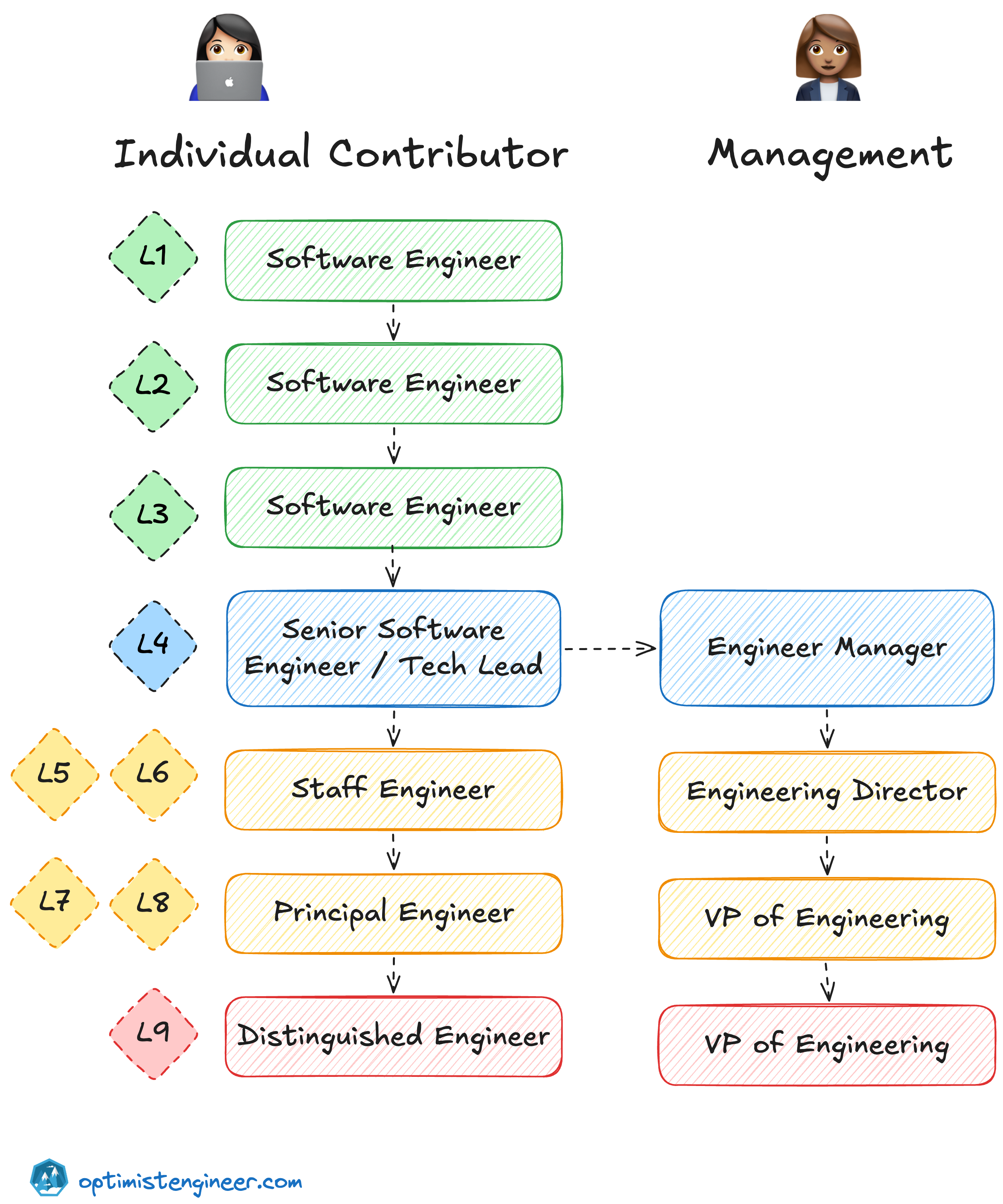
Luckily, that has changed. Today, you have two main paths to scale:
The Technical Track (Individual Contributor): This is your path if your passion is to stay close to the code and architecture. You evolve into high-impact roles like Tech Lead, Staff Engineer, or higher, where your focus is on solving strategic architectural challenges without involving yourself in the hierarchical management of people.
The Management Track (Engineering Manager): Your responsibility shifts. Your core focus is no longer coding, but genuinely caring about the career development of your engineers, aligning product goals, and ensuring your team has what it needs to perform at its best. It’s a different mindset.
Attitude is Everything: Openness to Change
If you just graduated or even if you are already a Senior, there is something fundamental you must internalize: openness to change.
In job interviews, it is assumed that you have a solid programming foundation. What truly sets you apart is your reaction when asked:
I know you master Java, but if the project requires it, would you be willing to code in Rust?
People who show open-mindedness:
yes, I will learn whatever is necessary.
These are precisely those who end up making huge leaps in their careers.
Act Like the Role You Aspire To
I’m going to be direct:
👉🏼 No one is going to come out of nowhere to say:
we’re promoting you,
So then you start acquiring responsibilities.
Especially from Senior roles onwards, you must act like the role you want to obtain before it is officially granted to you.
☝🏼 You must proactively demonstrate that you are capable of making design decisions, arguing at a technical level, and leading de facto. It is the only way to make it clear that the position already belongs to you morally.
Make Your Work Visible
This is, by far, the point where we technical profiles fail the most. I know, for those reading this newsletter, this already sounds familiar to you.
Still.
In an early-stage startup, it’s easy for your manager to see the quality of your work directly. But when the organization scales, your Engineering Manager will be swamped with obligations; they will no longer have eyes to see the daily grind of the whole team.
👉🏼 You have to make it noticeable. It depends exclusively on you.
Strategically leverage your 1-on-1s or your evaluations. Don’t improvise; bring data. Show charts: Look at how the number of bugs in production has dropped since I implemented my initiative,” or “I’ve managed to reduce our infrastructure cost by 12%.” If you don’t value your own effort, no one else is going to come to tell management how great you’ve done.
✨ Takeaways
Let’s wrap up. Load these concepts into your backpack:
Growth is measured by impact, not years: Seniority does not guarantee promotions.
Choose your path: Decide if you provide more value solving technical challenges (Individual Contributor track) or empowering other people (Engineering Manager track).
Embrace flexibility: Your adaptability to new ecosystems is your main competitive advantage.
Act in the role before you have the title: Lead at the level of the position you want to prove you are ready.
Visibility is vital: Document, quantify your successes, and proactively present them to your manager in your 1-on-1s.
I hope this edition has given you the focus you need to boost your next professional step with energy. Do you have something to share about it? drop me a message!
Agree that there’s no “we are promoting you”. Realistically, there’s only “you’re already performing on that next level so we’re going to revise your level to match it”.
Performance needs to get there first before the career level change.