

In modern microservices environments, ensuring that all services agree on the format and structure of shared data is crucial.
☝🏼A Schema Registry acts as the central source of truth for data schemas, helping teams manage schema evolution, enforce compatibility rules, and facilitate seamless communication between distributed services.
In today’s issue, I will address:
What a Schema Registry is.
Benefits of Using a Schema Registry.
Use Cases Where Schema Registries Are Essential.
When Schema Registries Are Not Worth It
Major Schema Registry Solutions Comparison.
Let’s start.
🧐 What a Schema Registry is
☝🏼A Schema Registry is a centralized repository for storing and retrieving data schemas.
👉🏼 It is designed to handle version control, ensuring that any evolution in the data structures is tracked and managed.
By maintaining a clear contract between producers and consumers, the registry enables reliable serialization and deserialization of data formats such as Avro, Protobuf, and JSON Schema, among others.
In a microservices architecture, during the sync and async communication, you have to ensure that the data you will write and read is compatible with your services.
👉🏼 Basically, the producer of the data could use a version of the data, version 1.2.0, and the consumers could use the same or an older version, like 1.1.0, without breaking either side. That’s the magic that a Schema Registry does for you.
☝🏼 Thinking about your code. The different Schema Registries offer SDKs for many languages, so you can serialize and deserialize data using the API offered by the SDK.
For example, when using an asynchronous API through Apache Kafka, you will have to configure your consumer with the deserializer class offered by the SDK from the Schema Registry you have chosen.
I already anticipated one of the major benefits of using a Schema Registry, but let’s explore more.
💡 Benefits of Using a Schema Registry
I could enumerate some, like:
Centralized Management: It provides a single source of truth for all data contracts, simplifying maintenance across microservices. And having a single source of truth in a distributed system means a lot!
Schema Evolution: The registry supports versioning and controlled evolution, which allows for backward, forward, or full compatibility as business requirements change.
Data Quality and Consistency: Enforcing compatibility rules helps prevent errors that might occur due to mismatches in data structure between services.
Reduced risk of breaking change: With clear contracts defined, teams can build services independently while ensuring they communicate correctly using standardized data formats.
Enhanced Monitoring and Governance: It provides audit trails and version histories, enabling teams to track changes and troubleshoot issues more efficiently.
How does it sound to you?
But still, is a Schema Registry something you really need? Let’s explore the use cases.
🎯 Use Cases Where Schema Registries Are Essential
1. Schema evolution without breaking producers or consumers
In event-driven systems, data models evolve over time. Fields are added, renamed, deprecated, or reorganized. In a distributed architecture where producers and consumers evolve independently, these changes can introduce incompatibilities if they are not managed properly.
👉🏼 A schema registry allows schemas to be versioned and compatibility rules to be enforced so that changes can be introduced without breaking existing services.
Without a registry:
Each team manages its own data model in code.
Schema changes can break existing consumers, and problems are often discovered only at runtime.
Teams need to coordinate deployments to avoid incompatibilities.
With Schema Registry:
Schemas are stored in a centralized and versioned location.
Compatibility rules, such as backward or forward compatibility, can be enforced.
Incompatible changes are detected before the producer can publish messages.
2. Explicit contracts between teams
In microservices architectures or streaming systems, events act as interfaces between different services or teams. For these interactions to be reliable, the structure of the messages must be clearly defined and accessible to all participants.
👉🏼 A schema registry allows the data model to become a formal, versioned contract that producers and consumers can rely on.
Without a registry:
The schema usually lives in code or informal documentation.
Consumers need to infer the message structure themselves.
It is common to see mismatches between documentation and the actual messages being produced.
With Schema Registry:
The schema becomes a central source of truth.
Producers and consumers rely on the same contract definition.
Versioning allows the contract to evolve in a controlled way.
3. Automatic validation of messages
A common issue in data platforms or event-driven systems is the presence of messages with incorrect structures or missing fields. These problems can cause failures in consumers or even break entire data pipelines.
👉🏼 A schema registry enables automatic validation to ensure that messages comply with the registered schema before they are published or processed.
Without a registry:
Producers can send messages with inconsistent structures.
Consumers must implement manual validation logic.
Errors are often detected late, after the message has already entered the system.
With Schema Registry:
Messages are validated against the registered schema.
Producers cannot publish invalid data.
Data quality and consistency across the system are improved.
At this point, you may think:
Damn! I need to put a Schema Registry right now!
Wait, and let’s see when it does not make sense.
❌ When Schema Registries Are Not Worth It
1. Only one producer and one consumer that are tightly coupled
When the producer and the consumer belong to the same system, the same repository, or the same team, schema evolution can be managed directly in the code and through coordinated deployments.
👉🏼 In this situation, introducing a registry adds an additional operational dependency without solving any real decoupling problem.
Without a registry:
The schema lives in the same repository as the producer and the consumer.
Changes to the data model are deployed in a coordinated way.
Integration tests validate that both sides remain compatible.
With Schema Registry:
An additional service must be operated and maintained.
Serialization configuration and schema management introduce extra complexity.
There is little practical benefit because the system is already coordinated.
2. The system is still in a prototype or exploration phase
During the early stages of a project, data models tend to change quickly while ideas and architectural decisions are being validated. At that stage, the priority is iteration speed rather than strict governance of data contracts.
👉🏼 Introducing a registry too early adds friction to development and slows down the evolution of the system.
Without a registry:
Schemas can evolve rapidly together with the code.
Changes can be made without formal compatibility processes.
The team can iterate and refactor freely.
With Schema Registry:
Schema changes require version registration and compatibility validation.
Additional steps are added to the development workflow.
Development speed decreases in a phase where experimentation is important.
3. Messages do not represent structured data
A Schema Registry is designed to manage and validate structured data with clearly defined fields. If messages contain opaque payloads such as binary blobs, compressed files, or encrypted content, there is no meaningful structure to register or validate.
👉🏼 In this situation, introducing a registry does not provide any technical benefit.
Without a registry:
Messages are treated as opaque payloads.
Consumers handle the interpretation logic.
Only basic metadata may be validated if needed.
With Schema Registry:
There is no real structure to register or validate.
Compatibility rules cannot provide meaningful guarantees.
Infrastructure is added without delivering functional value.
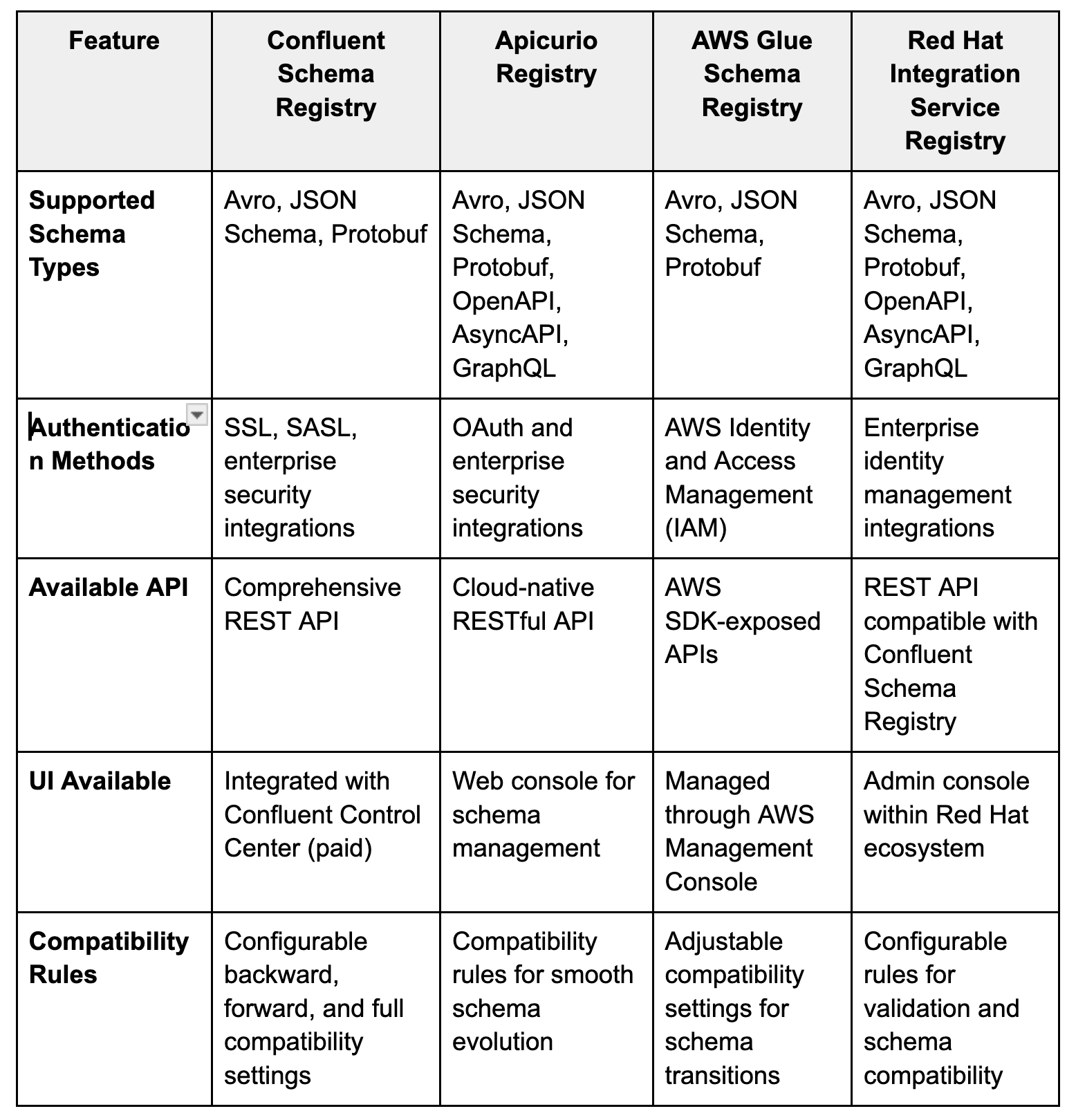
Before finishing for today, let me give you a comparison table for the Schema Registries I’ve analyzed recently.
📊 Major Schema Registry Solutions Comparison
This table provides an overview of key features and capabilities of each Schema Registry solution, making it easier to compare and select the best fit for specific needs.
✨ Takeaways
Let’s wrap up for today!
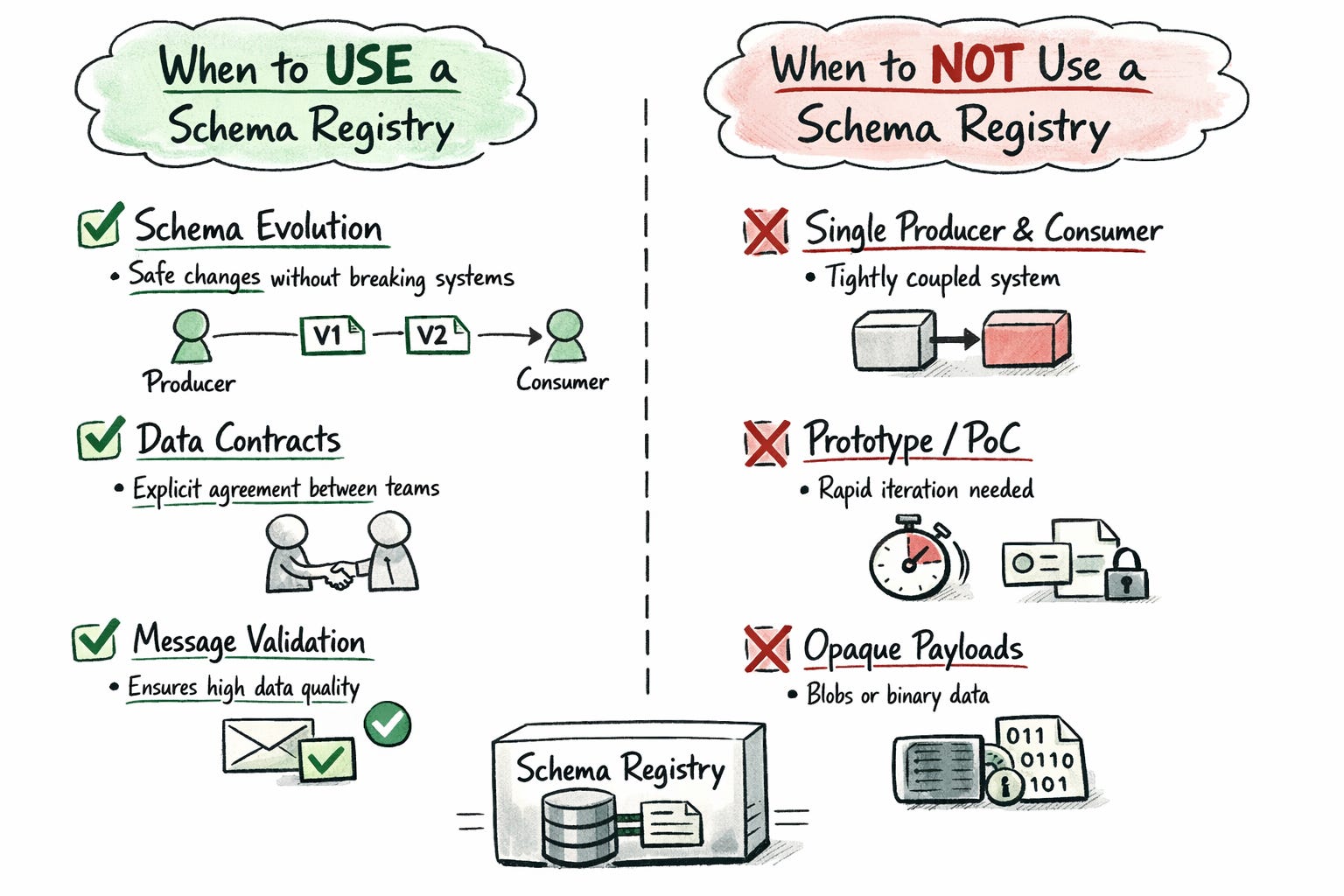
A Schema Registry acts as a central source of truth for data contracts in distributed systems. In microservices or event-driven architectures, where multiple producers and consumers evolve independently, maintaining a centralized repository of schemas allows all services to share a clear and versioned definition of the message structure.
One of its most important benefits is enabling schema evolution without breaking producers or consumers. Through versioning and compatibility rules such as backward or forward compatibility, teams can introduce changes to data models while ensuring that existing services continue to function correctly.
In addition, a Schema Registry significantly improves data quality and consistency. By automatically validating messages against the registered schema before they are published or consumed, it prevents malformed or incomplete data from entering the system and causing failures that are often difficult to detect at runtime.
However, it does not always provide value. When there is only one tightly coupled producer and consumer, or when a system is still in a prototype phase where data models change frequently, introducing a Schema Registry can add operational complexity without solving a real problem.
That’s it for today!
If you are building event-driven systems or microservices, sooner or later you will face the challenge of keeping data contracts consistent across services.
A Schema Registry can solve that problem, but as we saw, it only makes sense in the right context.
Have you used a Schema Registry in your architecture? What worked well, and what challenges did you face?
Leave a comment below, I read and reply to every single one!
Stay optimistic and keep building,
Thanks for your support and feedback, I really appreciate it!
You’re the best! 🖖🏼
𝘐𝘧 𝘺𝘰𝘶 𝘦𝘯𝘫𝘰𝘺𝘦𝘥 𝘵𝘩𝘪𝘴 𝘱𝘰𝘴𝘵, 𝘵𝘩𝘦𝘯 𝘤𝘭𝘪𝘤𝘬 𝘵𝘩𝘦 💜. 𝘐𝘵 𝘩𝘦𝘭𝘱𝘴!
𝘐𝘧 𝘺𝘰𝘶 𝘬𝘯𝘰𝘸 𝘴𝘰𝘮𝘦𝘰𝘯𝘦 𝘦𝘭𝘴𝘦 𝘸𝘪𝘭𝘭 𝘣𝘦𝘯𝘦𝘧𝘪𝘵 𝘧𝘳𝘰𝘮 𝘵𝘩𝘪𝘴, ♻️ 𝘴𝘩𝘢𝘳𝘦 𝘵𝘩𝘪𝘴 𝘱𝘰𝘴𝘵.


