

AI, AI, AI, all over the place.
Your CEO, CTO, and even your CPO are telling you:
Use the AI as much as possible!
Or this other (my favourite)
So will be able to deliver faster than before!
I will not jump into this debate (today), but into another: the development of the in-house services that implement the Model Context Protocol, to be used by AI Agents in the IDE of the developers.
I’ve seen many folks in Platform Engineering teams start writing MCP-based services meant to be used by the dev teams, and I wondered:
Hey, does this actually solve a problem for the dev teams?
In today’s issue, I want to share with you my vision about when an in-house MCP-based service makes sense.
Before jumping into it, I just wanted to let you know that I am writing another newsletter on how to move from Cloud Native foundations to AI‑powered platforms. You can subscribe here 👇🏻

Now, let’s get back to our business.
First of all, is this an automation?
Platform Engineering teams are meant to provide frameworks, CI/CD workflows, libraries, processes, and best practices to the Software Engineering teams so they can ship value to customers fast.
Platform Engineering teams have a great responsibility: choose the right solution so that Software Engineering teams will embrace and onboard the solution smoothly.
Since Software Engineering teams work with IDEs, and thanks to the existing integration between IDEs (VS Code, IntelliJ) and AI Agents, or existing IDEs like Cursor or Windsurf, one of the steps that could make sense is:
Let’s create an MCP-based service so developers can use it from their IDEs.
This is a great approach.
However, I’ve seen many Platform Engineering teams failing on this. Why?
👉🏼 They implemented an MCP-based solution when the feature teams needed just an automation.
Do not mix AI with automation; they are different things.
So, next time you think the solution is an MCP-based service, ask yourself the following:
Can the work be done by an automation?
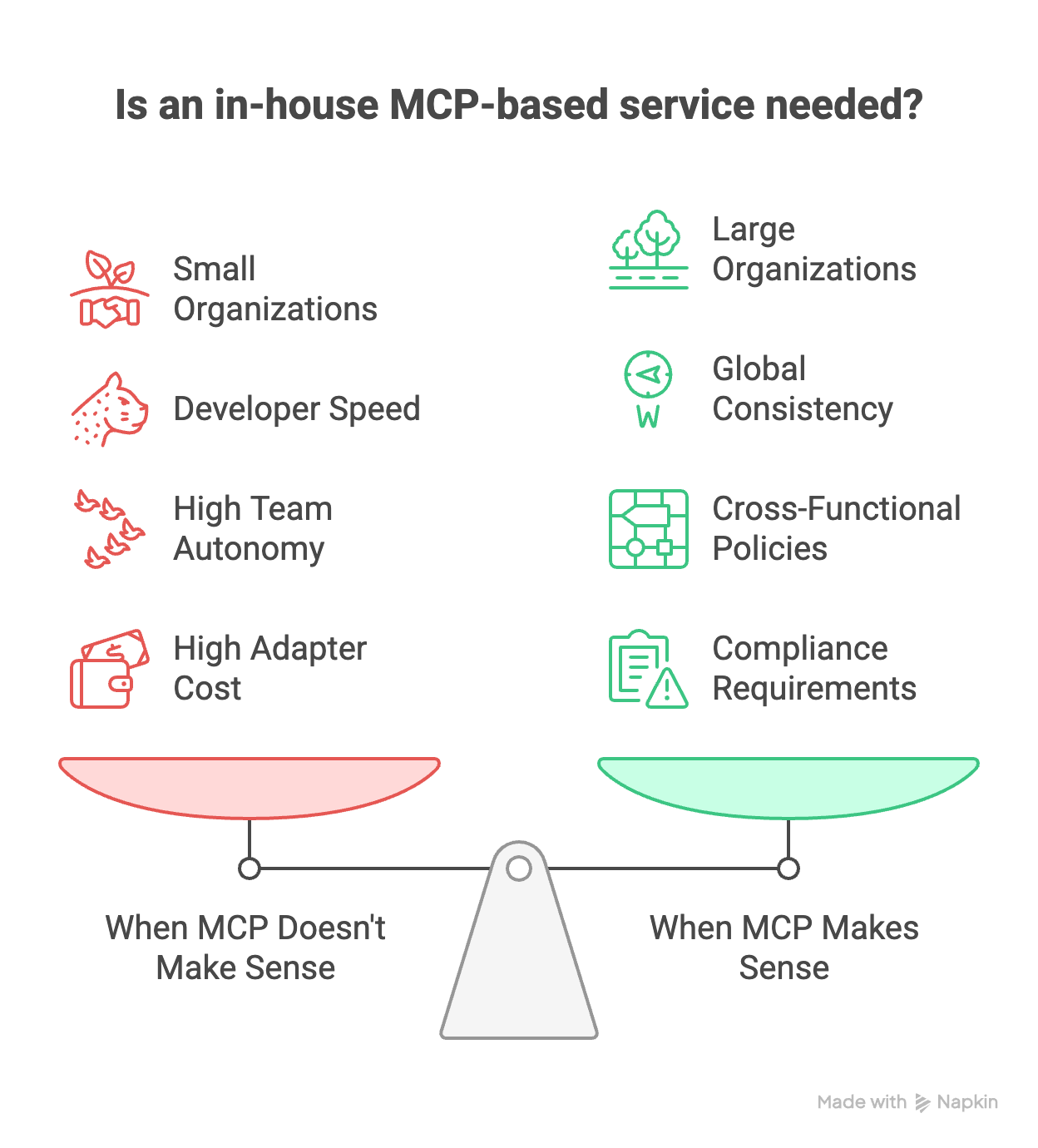
Is an in-house MCP-based service needed?
Look at this huuuge list of MCP servers available, many of them are official from their providers.
So, another question to ask yourself?
Will my MCP-based service solve a problem that isn’t already solved by existing MCPs?
I’ve intentionally made that question plural.
Connecting multiple MCP-based services to tools like Cursor or Windsurf already allows an AI Agent to solve problems that span multiple sources.
In fact, AI Agents can already orchestrate across the configured MCPs to resolve those problems.
So the real question is:
Why add another MCP that acts as a wrapper?
Maybe yes!, maybe no!
I’ve raised a couple of reflections that now your brain is trying to plug and play with the rest of your ideas. In order to help you, I will now list when it makes sense to create an MCP and when it does not.
When does an in-house MCP-based service not make sense?
Small organizations (1–2 teams) where the operational overhead of the MCP outweighs the benefits.
Top priority: developer speed and minimal friction (you prefer direct adapters in the IDE).
High team autonomy: with very different rules and an aversion to centralization, the MCP will become a source of political friction.
When the cost of maintaining adapters/compatibility outweighs the benefits, e.g., too many vendors with unstable APIs.
When does an in-house MCP-based service make sense?
You have >=10–20 teams with different policies and want global consistency (rulesets, RBAC, auditing).
You need correlation/dedupe between findings from multiple scanners (SAST, SCA, linters, Sonar, etc.) to prevent one bug from appearing as three.
Compliance/audit requirements: logging who automated what, blocking pull requests based on corporate policy, and evidence retention.
You’ll want to enforce cross-functional policies, like legal or privacy rules affecting all repositories, and enforce controlled downgrades when providers fail.
Let’s wrap up for today.
✨ Summary
Keep this in mind:
👉🏼 Just because you can implement an MCP-based service to solve a problem doesn’t mean you should.
From there:
Make an assessment of the problem you need to solve.
Is it something you can solve with automation?
Be sure you have the right expertise in the team to implement these kinds of tools.
Thanks for your support and feedback, I really appreciate it!
You’re the best! 🖖🏼
𝘐𝘧 𝘺𝘰𝘶 𝘦𝘯𝘫𝘰𝘺𝘦𝘥 𝘵𝘩𝘪𝘴 𝘱𝘰𝘴𝘵, 𝘵𝘩𝘦𝘯 𝘤𝘭𝘪𝘤𝘬 𝘵𝘩𝘦 💜. 𝘐𝘵 𝘩𝘦𝘭𝘱𝘴!
𝘐𝘧 𝘺𝘰𝘶 𝘬𝘯𝘰𝘸 𝘴𝘰𝘮𝘦𝘰𝘯𝘦 𝘦𝘭𝘴𝘦 𝘸𝘪𝘭𝘭 𝘣𝘦𝘯𝘦𝘧𝘪𝘵 𝘧𝘳𝘰𝘮 𝘵𝘩𝘪𝘴, ♻️ 𝘴𝘩𝘢𝘳𝘦 𝘵𝘩𝘪𝘴